




Digital Marketing Agency: The Complete Guide to Growth, Selection & ROI in 2026
Digital Marketing Agency: The Complete Guide to Growth, Selection & ROI in 2026
Choosing to work with a digital marketing agency is one of the most consequential decisions a business leader can make. It is not merely about outsourcing tasks; it is about investing in a strategic partnership that can redefine your company’s trajectory. In an era where consumers encounter thousands of brand messages daily, the expertise of a skilled agency is no longer a luxury but a necessity for cutting through the noise and building meaningful connections.
The global marketing agencies market is valued at an estimated USD 473.57 billion in 2026, a figure that underscores the immense reliance businesses place on external marketing partners. This guide explores the full spectrum of what a digital marketing agency offers, how to select the right one, and what the future holds for this dynamic industry. Whether you are a startup founder or a seasoned marketing director, this comprehensive resource will equip you with the insights needed to navigate the landscape and achieve measurable results.
What Exactly Is a Digital Marketing Agency?
A digital marketing agency is a specialized firm that helps businesses establish, manage, and grow their online presence. These agencies serve as external partners, bringing together a diverse team of experts in areas such as search engine optimization (SEO), pay-per-click (PPC) advertising, content creation, social media management, and data analytics. Their primary objective is to develop and execute integrated strategies that attract, engage, and convert target audiences across the digital ecosystem.
Unlike a traditional advertising agency that might focus on broad brand awareness, a modern digital marketing agency is deeply rooted in performance and measurability. They analyze brand positioning, map customer journeys, and select the most effective channels to achieve specific business outcomes. By functioning as an extension of your team, they provide the agility and specialized knowledge required to adapt to the ever-evolving digital landscape.
Core Services Offered by a Digital Marketing Agency
The service portfolio of a digital marketing agency is extensive and multifaceted, designed to cover every aspect of online customer acquisition and retention. Understanding these core offerings is the first step in identifying which services align with your business goals. A full-service agency acts as a one-stop shop, integrating various disciplines into a cohesive strategy.
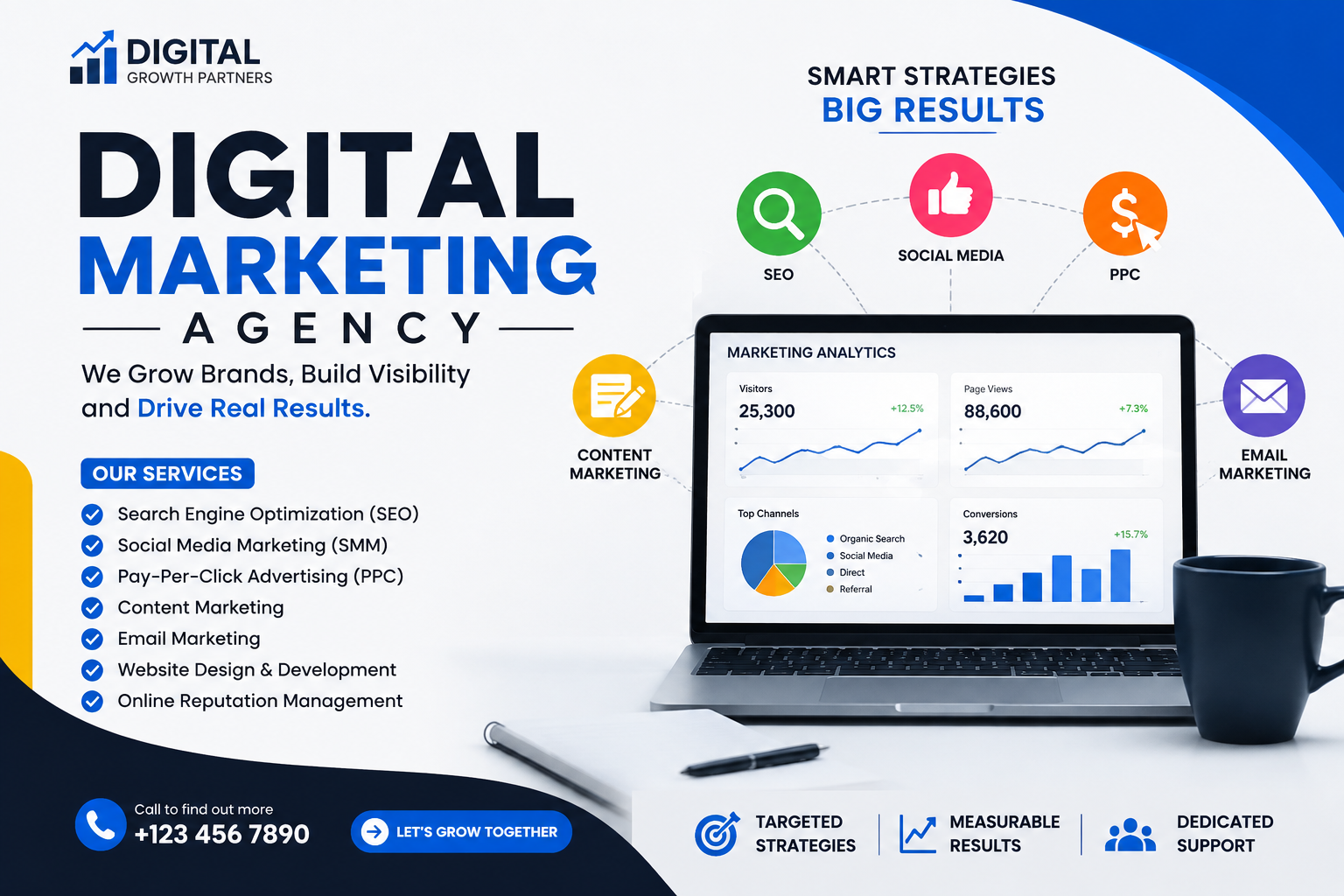
Search engine optimization (SEO) remains the bedrock of digital visibility, with over 90% of online experiences beginning with a search engine. Agencies conduct in-depth keyword research, optimize on-page elements, and build high-quality backlinks to improve organic rankings. Complementing this is pay-per-click (PPC) advertising, which delivers immediate, targeted traffic through platforms like Google Ads and social media networks. Content marketing, social media management, and email marketing further support the funnel by nurturing leads and building brand loyalty.
The Strategic Value of Partnering with a Digital Marketing Agency
Partnering with a digital marketing agency shifts marketing from a fixed overhead cost to a scalable growth investment. Instead of bearing the expense of recruiting, training, and retaining a full in-house team across multiple disciplines, businesses gain instant access to a pool of specialized talent. This model is particularly advantageous in today’s fast-paced environment, where marketing channels and technologies evolve rapidly.
Agencies also bring an external, objective perspective that internal teams often lack. Being too close to the brand can create blind spots, whereas an agency can identify missed opportunities and inconsistencies in messaging. Furthermore, they offer continuity; when a key internal team member leaves, marketing momentum can stall, but agencies provide stability through established processes and dedicated account teams. This combination of expertise, objectivity, and stability makes a digital marketing agency a powerful ally for sustainable growth.
How to Choose the Right Digital Marketing Agency
Selecting the right digital marketing agency is a decision that requires careful evaluation beyond the surface-level pitch. The goal is to find a partner that understands your commercial objectives, speaks the language of your industry, and can demonstrate a track record of solving problems similar to yours. This process begins internally with a clear definition of your business challenges and desired outcomes.
Before you start your search, define the precise problems you need to solve. Vague goals like “increase traffic” are insufficient; instead, anchor your search in tangible business outcomes such as increasing market share, generating qualified leads, or reducing customer churn. Once your objectives are clear, evaluate agencies based on their industry experience, the quality of their case studies, and the depth of their strategic thinking. A reputable digital marketing agency should provide clear outlines of services, costs, and expected outcomes, ensuring you know exactly what you are paying for.
Digital Marketing Agency vs. In-House Marketing: Making the Right Call
The debate between building an in-house team and hiring a digital marketing agency is no longer theoretical; the market is increasingly settling the argument. An in-house team offers complete brand control and internal communication efficiency, which can be beneficial for companies with highly predictable marketing requirements. However, the hidden costs of recruitment, software subscriptions, and ongoing training can be substantial.
Conversely, a digital marketing agency provides immediate access to a team of specialists across SEO, paid advertising, content, and analytics without the burden of managing each resource individually. Agencies can launch campaigns within days or weeks, compared to the months it often takes to build an internal team. While an in-house team brings deep product knowledge, the agency brings specialist expertise and a fresh perspective that can be critical for scaling and innovation. For many businesses, a hybrid model—where internal strategy is complemented by agency execution—offers the best of both worlds.
Measuring Success: ROI and Performance Metrics
Demonstrating return on investment (ROI) is the ultimate measure of a successful partnership with a digital marketing agency. Modern agencies move beyond vanity metrics like likes and followers, focusing instead on tangible business outcomes such as lead quality, conversion rates, and revenue growth. Advanced analytics and multi-touch attribution are now essential for accurately tracking the customer journey and proving value.
For instance, a boutique digital marketing agency managing $480K in monthly ad spend was able to prove 334 true attributed conversions for a client, compared to the 89 that single-platform reporting suggested. This level of insight transformed their client relationships from defense to offense. Such data-driven approaches are becoming standard, with agencies leveraging AI to provide real-time dashboards and optimization recommendations. The shift toward performance-based pricing models further aligns agency incentives with client success, tying fees to metrics like lead volume or incremental sales.
Best Action Movies 2025: Top Thrillers, Explosive Stunts & Must-Watch Films
The Future of the Digital Marketing Agency Industry
The digital marketing agency landscape is undergoing a profound transformation driven by artificial intelligence and shifting client expectations. AI has moved from an experimental add-on to an embedded component of agency operations, integral to ideation, content creation, and campaign optimization. Adobe’s 2026 research found that 76% of businesses say generative AI has improved content ideation and production speed. However, the real value lies not in generating more content, but in building smarter marketing systems that create growth and trust.
Agencies are also recalibrating their business models, moving from delivering services to helping clients build AI-enabled systems. This shift requires a focus on human insight, with AI serving as an acceleration tool rather than a replacement for creative strategy. As the industry evolves, agencies that specialize, embrace data-driven strategies, and prioritize transparency and trust will drive the greatest value. The market is projected to grow to USD 591.63 billion by 2031, indicating a robust future for agencies that can adapt and innovate.
FAQs
What does a digital marketing agency actually do?
A digital marketing agency develops and executes comprehensive online marketing strategies to help businesses attract, engage, and convert customers. Their services include search engine optimization, pay-per-click advertising, social media management, content creation, email marketing, and data analytics. They act as an external partner, providing specialized expertise and resources to achieve specific business goals like lead generation, brand awareness, and revenue growth.
How do I know if my business needs a digital marketing agency?
Your business may benefit from a digital marketing agency if you lack internal expertise in specific digital channels, need to scale your marketing efforts quickly, or are not seeing a sufficient return on your current marketing investments. Agencies provide access to a team of specialists across multiple disciplines, offer a fresh external perspective, and can often launch campaigns faster than building an in-house team.
How much does it cost to hire a digital marketing agency?
The cost of hiring a digital marketing agency varies widely based on the scope of services, the agency’s location, and its level of expertise. Globally, the average hourly rate is around $97 per hour, with U.S. agencies averaging $124 per hour. Project budgets commonly range from $1,000 to $25,000, with many agencies offering flexible retainer models or performance-based pricing tied to specific outcomes.
What is the difference between a full-service and a specialized digital marketing agency?
A full-service digital marketing agency offers a broad range of services, including SEO, PPC, content marketing, social media, and web development, making them a one-stop shop for all your digital needs. A specialized agency, on the other hand, focuses on one specific area, such as SEO or PPC, offering deep expertise in that particular discipline. The right choice depends on whether you need a comprehensive strategy or niche expertise.
How long does it take to see results from a digital marketing agency?
The timeline for seeing results depends on the specific services being used. PPC advertising can generate immediate traffic and leads within days, while SEO is a long-term strategy that typically takes three to six months to show significant organic ranking improvements. Content marketing and social media strategies also require consistent effort over several months to build momentum. A reputable digital marketing agency will set realistic expectations and provide regular performance reports to track progress.
Conclusion
Engaging a digital marketing agency is a strategic investment in your company’s future. From providing access to specialized talent and cutting-edge technology to offering an objective external perspective, the right agency can be a catalyst for significant growth. The key to success lies in a clear understanding of your goals, a thorough selection process, and a partnership built on transparency and mutual accountability.
As the industry continues to evolve with AI and data-driven strategies, the most successful agencies will be those that blend technological prowess with human creativity. By choosing a partner that aligns with your values and objectives, you can transform your digital presence and achieve sustainable, measurable results. The journey to digital excellence is complex, but with the right digital marketing agency by your side, it is a journey well worth taking.