












The Ultimate 5e Druid Spells Guide: Master Every Circle & Spell Level
The Ultimate 5e Druid Spells Guide: Master Every Circle & Spell Level
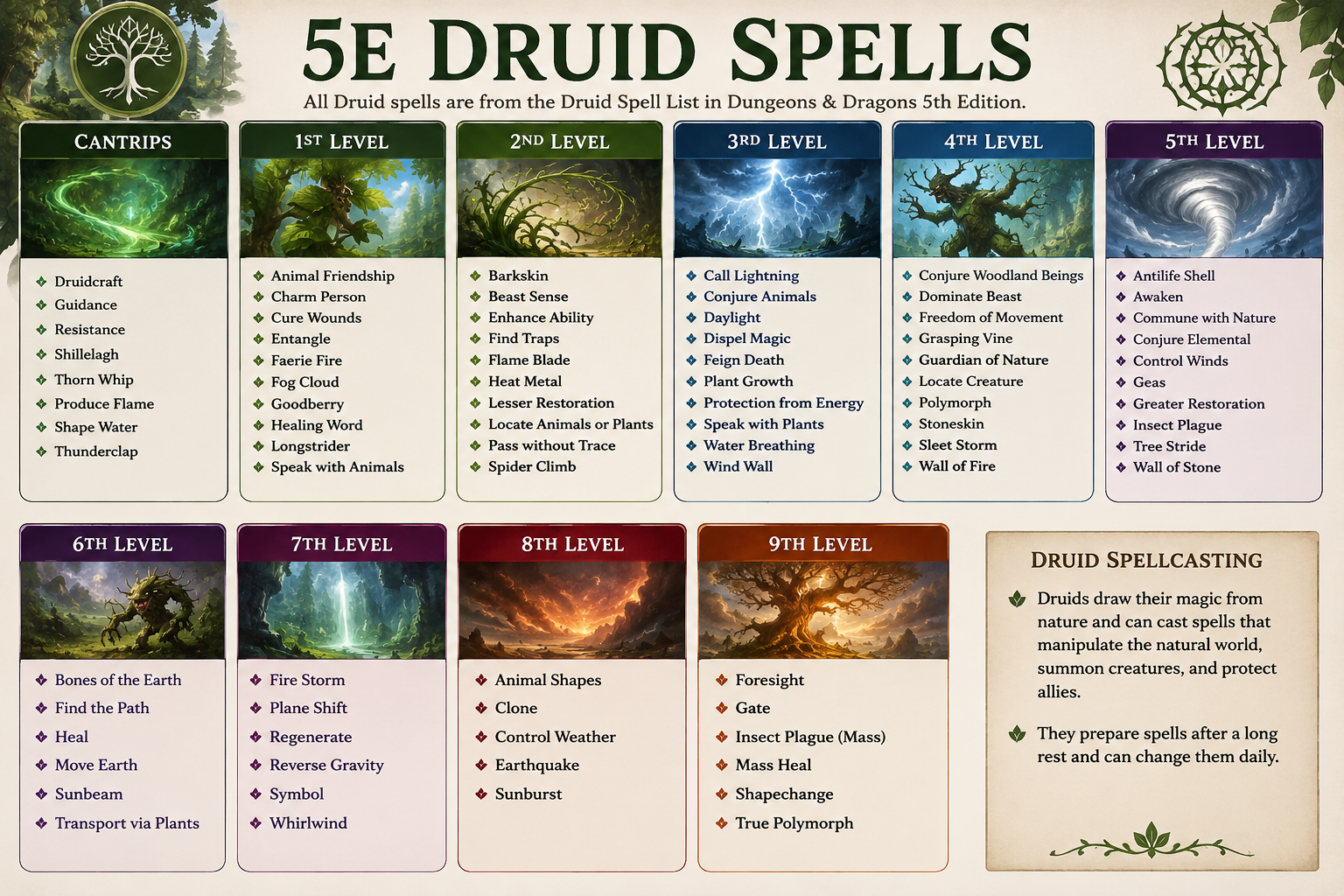
Few classes in Dungeons & Dragons offer the sheer versatility of the druid. Whether you envision your character as a savage beast-shifter, a serene guardian of ancient forests, or a master of primal storms, your effectiveness hinges on one thing: your choice of 5e druid spells. This comprehensive guide breaks down the entire druid spell list, offering strategic insights to help you select the perfect arsenal for any adventure. We’ll explore standout options from cantrips to ninth-level catastrophes, ensuring you wield nature’s power with confidence and tactical precision.
Understanding the Druid’s Unique Spellcasting
Druids don’t learn spells in the traditional sense; they prepare them from the full 5e druid spells list each day. This divine-style preparation means you have access to the entire catalog of druid magic, provided you have the spell slots to cast them. Your Wisdom modifier determines how many spells you can prepare, granting you incredible flexibility to tailor your magical toolkit to the challenges ahead. Unlike wizards who must find scrolls, you simply commune with nature each morning to reshape your capabilities, making the druid one of the most adaptable casters in the game.
This preparation system demands strategic foresight. While a wizard might be stuck with a fire spell against fire-immune foes, a druid can pivot entirely, swapping out Burning Hands for Entangle or Speak with Animals after a long rest. This adaptability is the core strength of 5e druid spells, encouraging players to think ahead about the environment, enemy types, and party composition. However, it also requires careful study of the spell list to know which tools are essential for your campaign’s specific trials.
Cantrips: The Druid’s Reliable Toolkit
Cantrips are the bread and butter of any spellcaster, providing unlimited utility and damage without consuming spell slots. For druids, these at-will abilities often define their early-game identity and remain useful throughout their career. Guidance is arguably the most impactful support cantrip in the game, offering a d4 bonus to ability checks for nearly any situation. Druidcraft allows you to predict weather, snuff flames, and create sensory effects, making it invaluable for roleplay and environmental interaction. For combat, Produce Flame provides reliable ranged damage and a light source, while Shillelagh transforms your quarterstaff into a formidable magical weapon for melee.
When selecting cantrips, consider the balance between utility and combat. Thorn Whip offers excellent battlefield control by pulling enemies closer, while Create Bonfire can lock down an area with persistent damage. A common misconception is that druids should only take damage cantrips; in truth, the utility of Mending or Guidance often provides more value over a campaign than an extra damage option. Choose cantrips that complement your party’s weaknesses—if you lack a rogue, Guidance can help with stealth; if you lack a wizard, Druidcraft and Mold Earth can solve environmental puzzles.
Level 1 Spells: The Foundation of Primal Power
First-level 5e druid spells establish your role in the party, offering critical healing, control, and utility. Entangle remains a standout, creating difficult terrain that can restrain multiple foes, effectively shutting down melee attackers. Goodberry provides a reliable source of healing and sustenance, allowing you to feed your entire party with a single spell slot—a lifesaver in survival-heavy campaigns. For healing, Cure Wounds offers significant single-target recovery, while Healing Word provides the invaluable ability to bring an ally back from unconsciousness as a bonus action.
The tactical depth of these spells cannot be overstated. Faerie Fire grants advantage on attack rolls against affected enemies, making it a premier support option for parties with heavy hitters. Thunderwave offers a powerful area-of-effect push, ideal for creating space when you’re surrounded. When preparing your daily spells, prioritize versatility—Detect Magic and Speak with Animals are ritual spells that don’t consume slots when cast as rituals, making them always worthwhile to have prepared. This foundation of 5e druid spells sets the stage for your character’s growth, blending offense, defense, and exploration seamlessly.
Level 2 Spells: Control and Utility Expand
As you gain access to second-level spells, your ability to shape the battlefield and support your party grows exponentially. Pass Without Trace is a game-changer for stealth, granting a +10 bonus to Dexterity (Stealth) checks to your entire party for an hour. This single spell can turn a dangerous infiltration into a trivial exercise, making it one of the most powerful utility options in the game. Spike Growth transforms an area into treacherous terrain, dealing damage to any creature that moves through it—perfect for funneling enemies or protecting a retreat.
Barkskin provides a reliable AC boost, though its value depends on your party’s needs. Flaming Sphere offers persistent damage and area denial, while Hold Person can neutralize a dangerous humanoid foe. The concentration mechanic becomes increasingly important at this level; you can only maintain one concentration spell at a time, so choose wisely. For example, maintaining Pass Without Trace during an infiltration means you cannot also use Spike Growth for combat—plan your spell usage around the expected encounter type.
Level 3 Spells: Summoning and Storm Calling
Third-level 5e druid spells mark a significant power spike, introducing iconic abilities like Call Lightning and Conjure Animals. Call Lightning allows you to call down bolts of lightning each round, providing sustained damage over a combat encounter. Conjure Animals is one of the most versatile spells in the game, summoning fey spirits in the form of beasts to fight alongside you. The tactical applications are immense—you can summon eight wolves to surround an enemy, or two giant eagles to provide aerial support or transportation.
Plant Growth offers immense battlefield control, creating an area of difficult terrain that can slow entire armies. Protection from Energy grants resistance to a chosen damage type, shielding your party from elemental threats. When selecting third-level spells, consider your party’s composition—if you lack a dedicated damage dealer, Conjure Animals can fill that void; if you need control, Plant Growth and Sleet Storm are unmatched. This tier of 5e druid spells truly defines your character’s specialization, whether as a summoner, blaster, or battlefield controller.
Level 4 Spells: Nature’s Wrath Unleashed
Fourth-level spells bring devastating area control and powerful transformations. Guardian of Nature transforms you into a primal force, granting advantage on attacks or enhancing your mobility. Grasping Vine allows you to repeatedly pull enemies toward you, combining control with damage. Hallucinatory Terrain can disguise an entire area, creating illusions that can mislead entire armies or hide your party’s position. For those who prefer a more aggressive approach, Blight deals significant necrotic damage to a single target, capable of withering even the toughest foes.
The strategic value of these spells lies in their ability to reshape encounters. Freedom of Movement grants immunity to paralysis and restraint, making it invaluable against creatures like giant spiders or spellcasters. Polymorph offers incredible versatility, allowing you to transform an ally into a giant ape or a fleeing enemy into a harmless frog. As you progress, the choice of 5e druid spells becomes less about raw power and more about tactical flexibility—each spell should serve a specific purpose in your overall strategy.
Level 5 Spells: Mastery Over the Elements
Fifth-level spells represent mastery over nature’s most destructive forces. Awaken grants sentience to a beast or plant, creating a powerful ally or a memorable NPC. Greater Restoration removes debilitating conditions like petrification or curse, often turning the tide of a campaign. Insect Plague creates a massive area of damage and difficult terrain, perfect for controlling large groups of enemies. Wall of Stone offers unparalleled defensive and offensive utility, allowing you to create fortifications or trap enemies.
The decision to take Commune with Nature or Tree Stride reflects your campaign’s focus—exploration versus combat. Summon Elemental calls forth a powerful ally that can take many forms, from a fiery salamander to an earth-shaking golem. At this level, 5e druid spells often define the campaign’s narrative, with spells like Awaken creating long-term story arcs and Greater Restoration resolving major plot points. Choose spells that align with your character’s goals and your Dungeon Master’s style.
Level 6-9 Spells: Cataclysmic Power
High-level druids wield power that can reshape kingdoms and challenge gods. Sixth-level spells include Sunbeam, a devastating beam of radiant damage, and Transport via Plants, which allows instant travel across vast distances. Seventh-level spells like Fire Storm offer immense area damage, while Mirage Arcane can transform a landscape entirely. Eighth-level spells include Tsunami and Earthquake, capable of leveling cities and altering geography. Ninth-level spells like Shapechange and Storm of Vengeance represent the pinnacle of druidic power, allowing you to assume the forms of ancient dragons or call down apocalyptic weather.
These cataclysmic spells are often campaign-defining. Shapechange allows you to become virtually any creature, providing unparalleled adaptability and power. Storm of Vengeance covers a massive area with devastating effects, capable of decimating armies. When preparing these high-level 5e druid spells, consider the scale of your campaign’s conflicts—these spells are not just tools but narrative devices that can permanently change the world around you.
Comparing the Best Druid Spells by Role
The versatility of the druid spell list means you can fill multiple roles within a party. The table below categorizes standout spells by their primary function, helping you build a balanced prepared list for any adventuring day.
| Role | Best Spells (by Level) | Key Benefits |
|---|---|---|
| Healing & Support | Cure Wounds (1), Healing Word (1), Goodberry (1), Pass Without Trace (2), Greater Restoration (5) | Reliable recovery, party buffs, and condition removal. |
| Battlefield Control | Entangle (1), Spike Growth (2), Plant Growth (3), Sleet Storm (3), Wall of Stone (5) | Area denial, crowd control, and tactical manipulation. |
| Damage Dealing | Thunderwave (1), Flaming Sphere (2), Call Lightning (3), Conjure Animals (3), Fire Storm (7), Earthquake (8) | Sustained damage, area-of-effect, and summoning support. |
| Utility & Exploration | Detect Magic (1), Speak with Animals (1), Druidcraft (0), Transport via Plants (6), Commune with Nature (5) | Scouting, communication, travel, and problem-solving. |
As the table illustrates, the druid’s spell list offers exceptional depth in every category. A well-rounded druid might prepare two control spells, two damage spells, and two utility spells each day, adjusting based on the anticipated environment. For example, a dungeon crawl might favor Pass Without Trace and Spike Growth, while a wilderness trek might prioritize Goodberry and Speak with Animals.
“Druids have one of the most impressive spell lists in fifth edition. In fact, they have over 20 exclusive spells.”
This quote underscores the uniqueness of the druid’s magical identity. Many 5e druid spells are exclusive to the class, offering abilities that no other caster can replicate, from speaking with plants to summoning fey spirits. This exclusivity reinforces the druid’s role as the ultimate guardian of nature, providing a distinct and irreplaceable set of tools for any adventuring party.
United CCS: The Definitive Guide to Carbon Capture and Storage in America
Concentration Management: The Druid’s Strategic Resource
One of the most critical aspects of mastering 5e druid spells is understanding the concentration mechanic. Many of the druid’s most powerful spells, including Entangle, Spike Growth, Call Lightning, and Conjure Animals, require concentration. You can only maintain one concentration spell at a time, meaning you must choose carefully which effect to prioritize in combat. Losing concentration due to damage can prematurely end a spell, so maintaining a high Constitution saving throw bonus or positioning yourself safely is essential.
Effective concentration management separates good druids from great ones. For example, casting Conjure Animals at the start of a fight provides a lasting advantage, but you cannot then cast Call Lightning unless you drop concentration on the animals. Consider the fight’s duration—Call Lightning excels in long battles, while Conjure Animals offers immediate action economy. Planning your spell progression around concentration ensures you maximize each spell slot’s impact without wasting resources on overlapping effects.
FAQs
What are the best 5e druid spells for beginners?
For beginners, focus on versatile, easy-to-use spells like Guidance, Entangle, Goodberry, and Healing Word. These 5e druid spells provide a strong foundation in support, control, and healing without requiring complex tactical decisions. As you gain experience, you can expand into more specialized spells like Conjure Animals and Call Lightning.
How many 5e druid spells can I prepare each day?
The number of 5e druid spells you can prepare equals your druid level plus your Wisdom modifier. For example, a 5th-level druid with a Wisdom of 18 (+4) can prepare 9 spells each day. This selection can be changed after a long rest, allowing you to adapt to different challenges.
Do druids need to learn spells from scrolls?
Unlike wizards, druids do not need to learn spells from scrolls. They have access to the entire list of 5e druid spells and can prepare any spell from that list for which they have spell slots. This makes druids incredibly flexible, as they can change their entire spell list daily without needing to find new spells.
What is the best damage-dealing 5e druid spell?
For sustained damage, Call Lightning is exceptional, providing reliable damage each round. For single-target burst, Blight offers significant necrotic damage at 4th level. For area damage, Fire Storm and Insect Plague are devastating. The best choice depends on your party’s needs and the encounter type.
How important is concentration for 5e druid spells?
Concentration is crucial for many powerful 5e druid spells, including Entangle, Spike Growth, and Conjure Animals. You can only maintain one concentration spell at a time, so choose wisely. Protecting your concentration with feats like War Caster or maintaining a safe distance from enemies is essential to maximize your spell’s effectiveness.
Conclusion
The 5e druid spells list is one of the most versatile and flavorful in all of Dungeons & Dragons. From the humble Guidance cantrip to the world-shattering Storm of Vengeance, druids possess the tools to heal, harm, control, and explore with unmatched flexibility. By understanding the unique preparation system, mastering concentration management, and selecting spells that complement your party and campaign, you can wield nature’s power with authority and grace. Whether you’re a new player or a seasoned veteran, this guide provides the strategic foundation to make informed choices, ensuring your druid becomes an indispensable force in any adventure. Embrace the wild, trust in the primal magic, and let your spells tell the story of a true guardian of the natural world.