












All Modern Firearms Have Three Basic Groups of Parts. What Are These Parts? A Complete
All Modern Firearms Have Three Basic Groups of Parts. What Are These Parts? A Deep Dive into Firearm Architecture
Every firearm, from the sleekest tactical rifle to the most classic hunting shotgun, shares a common architectural foundation. Whether you are a first-time gun owner, a seasoned hunter, or simply curious about mechanical engineering, understanding this foundation unlocks confidence and competence. If you have ever asked yourself, “all modern firearms have three basic groups of parts. what are these parts?”, you are starting with the most fundamental question in firearm design.
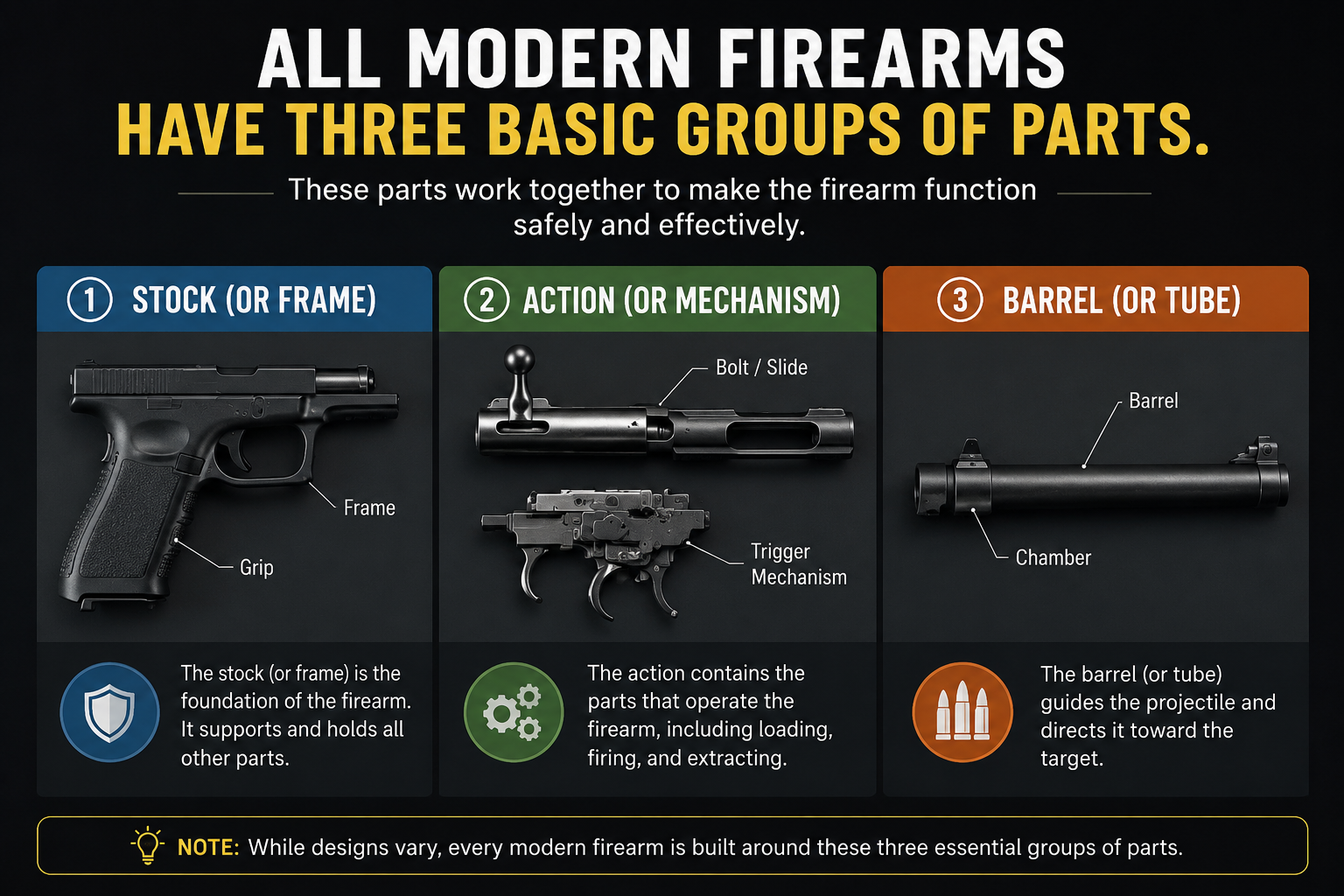
The answer to “all modern firearms have three basic groups of parts. what are these parts?” is elegantly simple: the action, the stock, and the barrel. This tripartite system is not just a random classification; it is the blueprint of firearm design refined over centuries. By breaking down a gun into these three fundamental categories, we demystify its operation, simplify maintenance, and enhance safety. In this comprehensive guide, we explore each group in meticulous detail, providing the authoritative knowledge to understand any firearm you encounter. So, all modern firearms have three basic groups of parts. what are these parts? Let us dive deep into each one to find out.
The Action Group: The Mechanical Heart of the Firearm
The action is arguably the most complex and critical component of any gun. When we ask, “all modern firearms have three basic groups of parts. what are these parts?”, the action is always the first answer, as it is responsible for loading, firing, and ejecting the cartridge. It is the engine room, containing the firing pin, trigger mechanism, breech bolt, and extractor. Without a functioning action, a firearm is nothing more than an inert metal tube.
The action is where the controlled explosion occurs. It must withstand immense pressure while maintaining precise timing to ensure the primer is struck at the exact moment the trigger is pulled. Different firearms utilize various action types—bolt-action, lever-action, pump-action, semi-automatic, and break-action—but they all serve the same primary functions. Understanding the action is the first step in answering “all modern firearms have three basic groups of parts. what are these parts?” because it is the most mechanically dense of the three.
The Stock Group: The Foundation of Control and Stability
While the action does the work, the stock provides the interface between the shooter and the machine. Continuing our exploration of “all modern firearms have three basic groups of parts. what are these parts?”, the stock is the second essential group. It is the part the shooter holds against their shoulder, cheek, or hands, serving as the structural backbone that connects the action to the barrel.
Stocks are designed with ergonomics in mind. They must position the shooter’s eye in alignment with the sights while providing a stable platform to absorb recoil. Materials have evolved significantly, moving from traditional hardwoods like walnut to synthetic polymers and advanced composites. When you consider “all modern firearms have three basic groups of parts. what are these parts?”, remember that the stock houses the trigger guard and often the magazine, making it a central hub for shooter interaction.
The Barrel Group: The Path of the Projectile
The barrel is the third and final essential group in the triad. If the action is the heart and the stock is the backbone, the barrel is the soul. To fully answer “all modern firearms have three basic groups of parts. what are these parts?”, we must look at the barrel, which provides the guided path for the bullet as it travels from the chamber to the muzzle.
Rifling, the spiral grooves inside the barrel, imparts a spin on the bullet to stabilize it in flight. The barrel must be manufactured to exacting tolerances to handle extreme heat and pressure. When shooters ask, “all modern firearms have three basic groups of parts. what are these parts?”, the barrel is the group that directly influences velocity and accuracy, making it a critical focus for anyone optimizing performance.
How These Three Groups Work Together in Harmony
To truly grasp the synergy of firearm design, one must appreciate how these groups interact. When you ask, “all modern firearms have three basic groups of parts. what are these parts?”, you must also understand that they are not isolated components but interdependent systems. When you pull the trigger, the action releases the firing pin, the barrel guides the bullet, and the stock absorbs the recoil and keeps you on target.
Consider a bolt-action rifle: the shooter manually cycles the bolt (action) to chamber a round, aims through the sights mounted on the barrel, and supports the rifle via the stock. The seamless integration answers why “all modern firearms have three basic groups of parts. what are these parts?” is such a powerful question—it highlights the consistent engineering principles across all makes and models.
Exploring Different Action Types
The action group is the most diverse of the three, featuring distinct mechanisms that define operation. Since we know “all modern firearms have three basic groups of parts. what are these parts?”, focusing on the action reveals variations like bolt-action, favored for accuracy, requiring manual cycling, and semi-automatic, using gas or recoil energy for rapid fire. Pump-action shotguns rely on a sliding fore-end, while lever-actions use a lever near the trigger guard.
Break-action firearms hinge open like a book for loading. Each type represents a different engineering solution, but they all fall under the action group. When a novice asks, “all modern firearms have three basic groups of parts. what are these parts?”, identifying the action type is often the first step in understanding a firearm’s capabilities and limitations.
The Critical Role of the Barrel in Accuracy
The barrel group is arguably the most influential factor in determining a firearm’s accuracy. When experts discuss “all modern firearms have three basic groups of parts. what are these parts?”, they emphasize that the quality of rifling, bore consistency, and chamber precision all contribute to bullet flight consistency. Match-grade barrels are investments in this specific group to ensure sub-MOA accuracy.
Beyond rifling, the barrel’s profile—whether heavy, tapered, or fluted—affects heat dissipation and rigidity. A heavy barrel maintains its shape during prolonged firing, reducing point-of-impact shift. So, when we answer “all modern firearms have three basic groups of parts. what are these parts?”, the barrel group demands the most attention when accuracy is the priority, as the physics of ballistics come to life there.
Stock Materials and Ergonomics
The stock group has evolved dramatically from simple wooden planks to high-tech synthetic designs. Modern stocks often feature adjustable cheek rests and length-of-pull spacers to accommodate different physiques. When you examine “all modern firearms have three basic groups of parts. what are these parts?”, the stock is the part that can be tailored to the individual for maximum comfort.
Synthetic stocks resist weather and warping, making them ideal for harsh environments, while wood stocks offer a classic aesthetic and natural recoil dampening. Advanced stocks incorporate recoil-reducing systems or integral bedding blocks that improve accuracy. The stock is the shooter’s direct connection to the machine, and its design significantly impacts the overall shooting experience, reinforcing why “all modern firearms have three basic groups of parts. what are these parts?” is a question of ergonomics as much as mechanics.
Maintenance and Care for Each Group
Proper maintenance is essential for reliable function. When cleaning, remember “all modern firearms have three basic groups of parts. what are these parts?” to ensure a comprehensive routine. The action group, with its many moving parts, requires regular cleaning and lubrication to prevent fouling and wear. The barrel group needs consistent bore cleaning to remove copper and carbon deposits that degrade accuracy.
The stock group, while less mechanical, benefits from periodic checks for cracks or loose fittings. A common misconception is that only the barrel needs cleaning, but neglecting the action leads to misfires. Because we know “all modern firearms have three basic groups of parts. what are these parts?”, a disciplined maintenance routine must address each group individually to ensure longevity.
Safety Considerations Across All Three Groups
Safety is paramount, and understanding the three groups enhances safe operation. When you ask, “all modern firearms have three basic groups of parts. what are these parts?”, you must also ask how each contributes to safety. The action contains the safety mechanism, which must be engaged until you are ready to fire. The barrel must be kept clear of obstructions; even debris can cause catastrophic failure. The stock must be firmly shouldered to manage recoil and maintain control.
Experienced instructors emphasize that because “all modern firearms have three basic groups of parts. what are these parts?” is a universal truth, checking each group during a safety inspection is a best practice. Before handling any firearm, visually inspect the action to ensure it is unloaded, check the barrel for obstructions, and verify the stock is secure. This systematic approach reduces accidents and builds disciplined habits.
Evolution of Firearm Design
The classification of firearms into three basic groups is the result of centuries of iterative design. Early firearms like the matchlock and flintlock had rudimentary actions, smoothbore barrels, and simplistic stocks. The industrial revolution brought mass production and interchangeable parts, solidifying the three-group architecture. Even today, when innovators ask “all modern firearms have three basic groups of parts. what are these parts?”, they are building on this historical foundation.
Innovation continues to push boundaries—carbon fiber and titanium appear in barrels and stocks, while actions become more sophisticated with drop-in triggers and quick-change barrels. Yet, despite these advancements, the fundamental truth remains: all modern firearms have three basic groups of parts. what are these parts? The action, stock, and barrel remain the core of every design, ensuring principles remain accessible to everyone.
Comparative Breakdown of Firearm Groups
To provide a clear overview, the table below summarizes the key characteristics of each of the three basic groups of parts, answering the question “all modern firearms have three basic groups of parts. what are these parts?” at a glance.
| Group | Primary Function | Key Components | Common Materials | Impact on Performance |
|---|---|---|---|---|
| Action Group | Loading, firing, ejecting | Bolt, trigger, firing pin, extractor, safety | Steel, aluminum, alloys | Reliability, rate of fire, trigger quality |
| Barrel Group | Guiding and spinning the bullet | Bore, rifling, chamber, muzzle | Chrome-moly steel, stainless steel, carbon fiber | Accuracy, velocity, heat management |
| Stock Group | Shooter interface and support | Buttstock, fore-end, grip, cheek rest | Wood, synthetic polymers, composites | Ergonomics, recoil management, stability |
This table illustrates that while all modern firearms have three basic groups of parts. what are these parts? we see that specific materials and designs within each group vary widely to suit different applications, from competitive shooting to military service.
“The genius of modern firearm design lies not in complexity, but in the elegant simplicity of its three-part system. When you ask, ‘all modern firearms have three basic groups of parts. what are these parts?’, the answer teaches you how to master the gun.” — This principle is taught in armorer schools worldwide because it simplifies training and enhances safety.
All Modern Furniture: The Ultimate Guide to Styles, Materials, and Trends in 2026
Practical Takeaways for Firearm Enthusiasts
For those looking to purchase their first firearm, understanding these three groups is invaluable. When evaluating a potential purchase, apply this framework: examine the action for smoothness, the barrel for cleanliness and rifling quality, and the stock for fit and comfort. Since you now know “all modern firearms have three basic groups of parts. what are these parts?”, you can apply this evaluation to any gun, regardless of price point or origin.
For competitive shooters, upgrading specific groups yields performance gains. Aftermarket barrels, custom triggers (action), and precision stocks are common upgrades. Recognizing that “all modern firearms have three basic groups of parts. what are these parts?” allows you to strategically invest in upgrades that align with your shooting discipline, transforming a standard firearm into a competition-ready tool.
FAQs
What exactly are the three basic groups of parts in a firearm?
Yes, all modern firearms have three basic groups of parts. what are these parts? They are the action group (which loads and fires), the barrel group (which guides the bullet), and the stock group (which provides support and control). Recognizing them is essential for proper handling and maintenance.
Why is the action group considered the most critical component?
When we ask, “all modern firearms have three basic groups of parts. what are these parts?”, the action is often the focus because it is the mechanical heart containing the trigger, bolt, and firing pin. It is the most complex group and directly influences the reliability and safety of the entire firearm.
How does the barrel group impact shooting accuracy?
The barrel group impacts accuracy through its rifling and bore consistency. Since all modern firearms have three basic groups of parts. what are these parts? The barrel is the primary determinant of how consistently a bullet flies, making its quality crucial for precision shooting.
Can I upgrade or replace individual groups on my firearm?
Absolutely. Many shooters upgrade specific groups to enhance performance. Aftermarket barrels, custom triggers (action), and precision stocks are common. Because you understand that all modern firearms have three basic groups of parts. what are these parts?, you can strategically select upgrades that are compatible with your specific model.
How often should I maintain each of these three groups?
Cleaning frequency depends on usage, but a general rule is to clean the barrel after every session to remove fouling, clean the action every few hundred rounds, and inspect the stock regularly for damage. Remember that all modern firearms have three basic groups of parts. what are these parts? Each group requires specific care to ensure longevity, reliability, and safety.
Conclusion
In summary, the architecture of every modern firearm is built upon three fundamental groups. Ultimately, when a shooter asks, “all modern firearms have three basic groups of parts. what are these parts?”, the definitive answer is the action, the barrel, and the stock. The action drives the mechanical cycle, the barrel ensures accuracy, and the stock provides control and comfort. This tripartite structure is the cornerstone of firearm literacy.
Whether you are maintaining your firearm, upgrading components, or simply learning to shoot, this knowledge empowers you to make informed decisions. The elegance of this design is its universality; from pistols to rifles to shotguns, the principles remain the same. By internalizing this framework, you elevate your understanding from casual observer to informed enthusiast. So, next time you handle a gun, remember the question and its answer: all modern firearms have three basic groups of parts. what are these parts? The action, stock, and barrel—working together in perfect mechanical harmony.